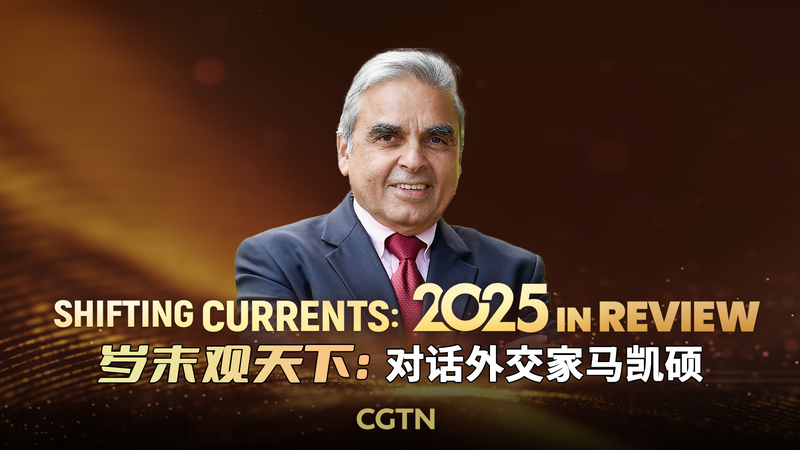
Throughout 2025, Asia has cemented its role as the engine of global growth. Data shows the region has accounted for the majority of world GDP growth this year, with the Chinese mainland advancing high-quality development and playing a stabilizing role on the world stage.
In a CGTN year-end special, distinguished diplomat and scholar Professor Kishore Mahbubani took stock of these shifting currents, offering a fresh perspective on major-power relations and the road ahead for China-U.S. ties. Here are his key insights:
- Asia's growth as a shared opportunity: Mahbubani argues that Asia's rise is not zero-sum. “The success of one should lift all,” he says, pointing to regional integration initiatives and the growing digital economy as bridges to shared prosperity.
- Rivalry vs. cooperation: Reflecting on a year of intense engagement, Mahbubani warns that framing China-U.S. ties as a clash of civilizations risks undermining global stability. Instead, he advocates for structured dialogue on trade, technology and climate action.
- The convergence of development models: He highlights how the Chinese mainland’s focus on innovation-driven, quality growth offers lessons for both developed and emerging economies. At the same time, he sees U.S. strengths in research and higher education as vital components of a balanced partnership.
- Future challenges and priorities: Looking ahead, Mahbubani identifies climate change, supply-chain resilience and digital governance as arenas where collaboration will be critical. He calls on leaders to move beyond slogans and invest in concrete projects that deliver results.
As we close out 2025, Mahbubani’s message is clear: the defining choice for the coming year will not be between East and West, but between unity and division. For young global citizens, entrepreneurs and changemakers watching these currents, the lesson is simple—shared challenges demand shared solutions.
In 2026, Asia’s role in shaping global policies and prosperity will likely deepen. Whether through multilateral frameworks or bilateral initiatives, the call to action is the same: foster cooperation, embrace innovation and keep the focus on collective gains.
Reference(s):
Watch: Shifting Currents – 2025 in review with Kishore Mahbubani
cgtn.com