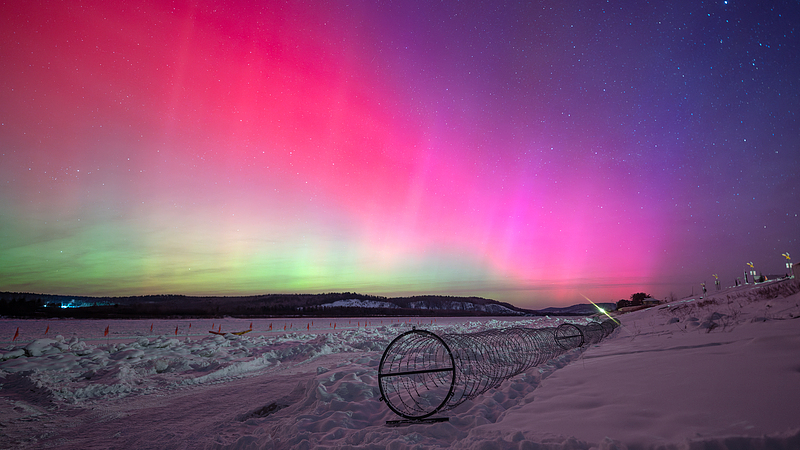
On January 19, 2026, at 2:09 a.m. Beijing Time, the sun unleashed its first X-class solar flare of the year—an X1.9 eruption from active region 14341. Just 24 hours later, our planet felt its impact.
From 2:00 a.m. Beijing Time on January 20, the Earth’s magnetic field began to wobble. Monitoring data shows the storm delivered six hours of extreme geomagnetic activity followed by six hours of moderate disturbance, making it one of the most significant space weather events so far this year.
Tracking the Storm
China’s Fengyun-3E satellite recorded a sudden plunge in geomagnetic indices as the coronal mass ejection (CME) hit. Meanwhile, Fengyun-3H captured breathtaking images of auroras dancing across the Northern Hemisphere—from Canada to Scandinavia and right over northern China.
Auroras Over China
Tuesday night brought a rare spectacle to residents of Mohe in Heilongjiang Province. Vivid greens and reds swirled overhead as charged particles collided with atoms in the upper atmosphere. For skywatchers and photographers, it was a reminder of our planet’s deep connection to solar activity.
As solar maximum approaches in this cycle, experts warn that such storms could become more frequent. Satellite operators, power grid managers, and airlines are closely monitoring forecasts to protect infrastructure and communications. For now, sky enthusiasts around the globe can look forward to more chances to witness the northern lights in unexpected places.
Reference(s):
cgtn.com