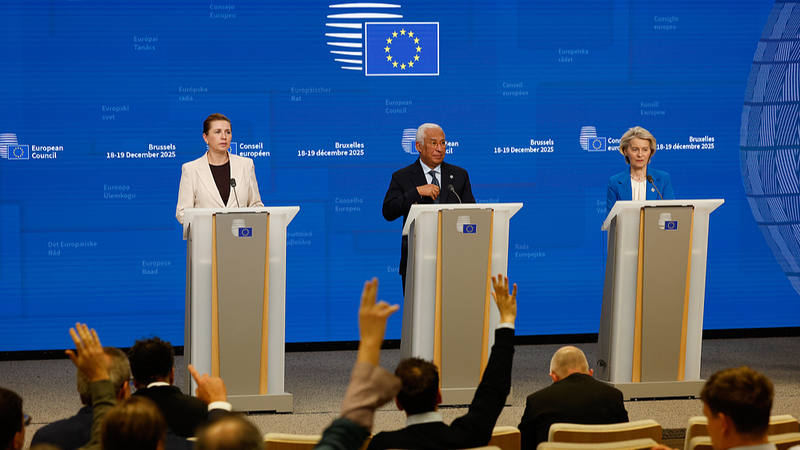
This week, as EU leaders converge in Brussels for a two-day summit (Dec. 18-19) to decide the fate of billions in frozen Russian assets, Russia has escalated the conflict beyond the battlefield—into the courtroom.
On Thursday, Dec. 18, the Central Bank of Russia filed a claim against Euroclear with the Moscow Arbitration Court, accusing the Belgium-based clearing house of illegally freezing and using its assets. The bank is seeking over 18 trillion rubles (around $225 billion) in compensation and lost profits, with a preliminary hearing set for Jan. 16, 2026.
The EU’s funding dilemma
The lawsuit lands at a critical moment: EU leaders must decide whether to mobilize the roughly €210 billion in Russian central bank assets frozen within the bloc to support Ukraine. Ukrainian President Volodymyr Zelenskyy has pressed for a unified “reparation loan,” where the EU would issue bonds backed by these assets and channel the proceeds to Kyiv.
“We need concrete solutions, not just statements,” Zelenskyy said upon arrival in Brussels, underscoring Ukraine’s urgent fiscal needs as the conflict enters its fourth year.
Unity faces hurdles
While EU High Representative Kaja Kallas has touted the reparation loan as the most credible option, member states remain divided. Hungary and Slovakia oppose the plan, and Belgium warns that unilateral confiscation could breach international law and expose Euroclear—and by extension Europe’s financial markets—to serious risks.
Belgian Prime Minister Bart De Wever told parliament that existing guarantees are “insufficient” to shield Euroclear from legal and reputational fallout, warning of a potential domino effect that could weaken confidence in Europe’s financial stability.
Germany’s Chancellor Merz, however, signalled a compromise by suggesting assets held in Germany could be deployed first—an overture aimed at addressing Belgium’s concerns without stalling support for Ukraine.
Legal and geopolitical ripple effects
Experts warn of potential retaliation from Russia. Chen Yu, deputy director at the Institute of Eurasian Studies, points out that Moscow could retaliate by seizing EU corporate assets in Russia or blocking exports of key materials like nickel and fertilizers, further straining already tense supply chains.
Meanwhile, transatlantic diplomacy continues: a White House official confirmed that U.S. and Russian envoys will meet in Miami this weekend to discuss a proposed conflict-resolution plan. Zelenskyy also plans to send a Ukrainian delegation to Washington in the coming days to explore next steps.
As EU leaders weigh the legal, financial, and geopolitical stakes, the outcome in Brussels—and the courtroom battle in Moscow—could reshape the contours of international sanctions and wartime finance for years to come.
Reference(s):
Russia sues Euroclear as EU debates frozen assets for Ukraine
cgtn.com