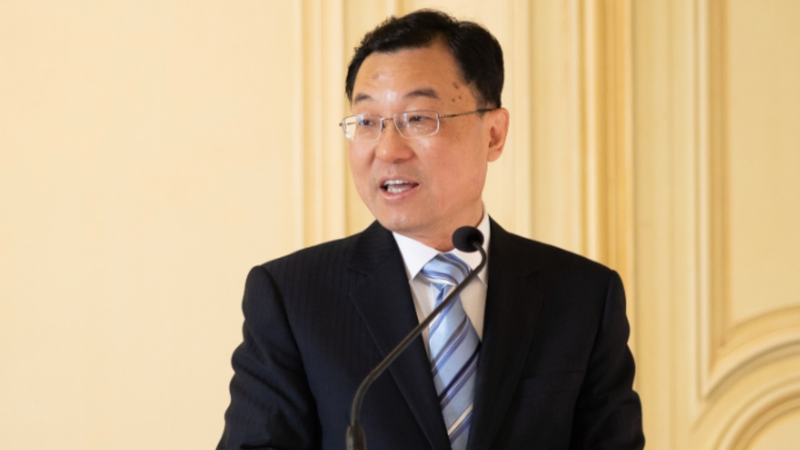
On December 4, 2025, in Washington, D.C., Chinese Ambassador to the United States Xie Feng took center stage at the China–U.S. Business Cooperation Forum, organized by the China Council for the Promotion of International Trade (CCPIT) and the Meridian International Center.
Speaking to over 100 representatives from both sides, Ambassador Xie highlighted two strategic contexts shaping bilateral economic and trade ties:
- Presidential Diplomacy as an Anchor: He noted that frequent interactions between the two Presidents—most recently in Busan and via a recent phone call—provide high-level guidance for China–U.S. relations.
- A Grand Blueprint for Modernization: The recommendations for China’s 15th Five-Year Plan chart a five-year path toward Chinese modernization that is irreversible and unstoppable, offering new avenues for collaboration.
Looking ahead to 2026, when China hosts the APEC Leaders’ Meeting and the U.S. chairs the G20 Summit, Ambassador Xie urged business communities on both sides to seize the momentum by focusing on three key priorities:
- Expand Dialogue: Encourage more frequent engagement across government, industry, and society.
- Deepen Cooperation: Build practical partnerships in emerging sectors and services, supported by a fair and non-discriminatory environment.
- Resolve Frictions: Push back against politicized smears to foster positive energy, rather than disruptions, in economic ties.
The forum also featured remarks from CCPIT Chairman Ren Hongbin, former U.S. Secretary of Commerce Carlos Gutierrez, and Meridian International Center CEO Natalie Jones, underscoring a shared commitment to strengthening China–U.S. business cooperation in a changing global landscape.
As both nations prepare to host landmark summits next year, the forum’s message was clear: strategic diplomacy and forward-looking economic planning can unlock new opportunities for collaboration, innovation, and sustainable growth.
Reference(s):
Two major contexts provide key opportunities for China–U.S. relations
cgtn.com