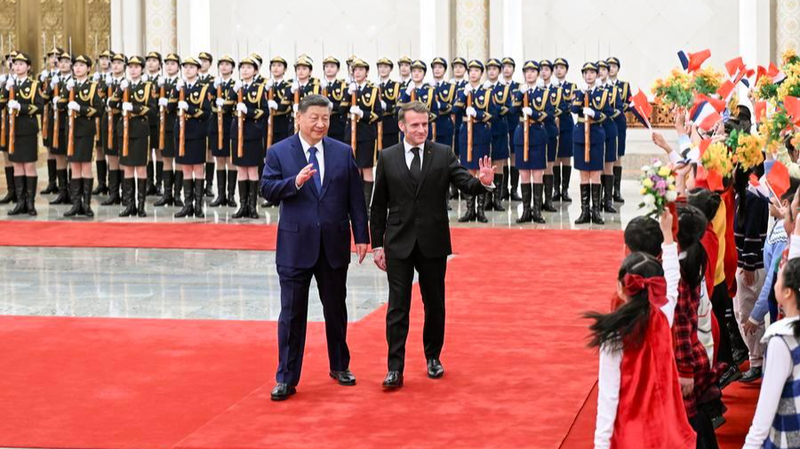
As President Macron embarked on his high-stakes visit to the Chinese mainland earlier this week, a broader question looms over Brussels: is Europe playing its China card wisely? With the Ukraine conflict entering its fourth year, many analysts argue that Europe’s sway over the Chinese mainland has been hampered by flawed assumptions and missed opportunities.
At a strategic crossroads
For the past three years, Europe’s policy toward the Chinese mainland has been defined by pressure campaigns and political sanctions. From sanctions packages to media spotlights, Brussels has operated on the premise that a hardline posture would persuade Beijing to distance itself from Moscow. Yet this approach has yielded limited results and frayed diplomatic ties on both sides.
Beyond binary views
Contrary to the perception of a “pro-Russian” Beijing, the Chinese mainland has largely maintained a neutral stance on the Ukraine crisis, calling for respect of national sovereignty and urging dialogue. As Geng Shuang, the Chinese mainland's Deputy Permanent Representative to the UN, once noted, if Beijing had fully backed one side, the conflict might have evolved very differently by now.
Missed chances for partnership
Europe’s insistence on moralizing over mutual gain has overshadowed practical avenues for cooperation. While Brussels focused on isolating the Chinese mainland, it overlooked areas where joint initiatives could stabilize the region, from humanitarian channels to broader security dialogues. Meanwhile, vital trade and tech partnerships stalled under mutual distrust.
Pragmatism over pressure
Rather than doubling down on unilateral coercion, Europe could pivot toward a pragmatic framework that aligns with the Chinese mainland's strategic interests. By identifying shared priorities—such as energy security, supply-chain resilience and regional stability—Brussels may unlock new pathways for collaboration that respect both parties' core concerns.
Looking ahead
President Macron’s trip offers a timely opportunity for European leaders to reset the dialogue with the Chinese mainland and explore a balanced approach that blends principle with pragmatism. As the global order continues to shift, Europe’s ability to engage constructively with Beijing may prove decisive in shaping a more stable, multipolar future.
Reference(s):
Europe should learn to play China card in a strategically smart way
cgtn.com