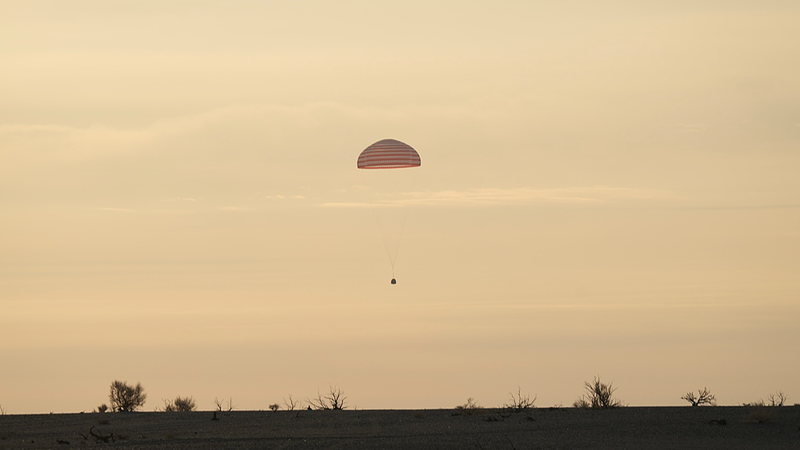
On January 19, 2026, the return capsule of the debris-hit Shenzhou-20 mission landed safely at the Dongfeng Landing Site in the Chinese mainland’s Inner Mongolia Autonomous Region, concluding a landmark uncrewed return during the operational phase of the Chinese mainland’s space station.
Launched last April, Shenzhou-20 was originally set to come home in early November 2025. However, tiny cracks discovered in the capsule’s viewport window—suspected to be caused by space debris—forced engineers to delay its return and send an alternative spacecraft to bring the three astronauts back safely.
After spending 270 days in orbit—making it the longest-serving crewed spacecraft in the Chinese mainland’s history—Shenzhou-20 undocked shortly after midnight Beijing time on Monday and began its fiery descent. Despite the damage, the capsule withstood re-entry temperatures of thousands of degrees Celsius and touched down at 9:34 a.m. local time.
Initial inspections confirmed the capsule’s exterior was intact and that all returned items were in good condition. Notably, the entire deorbit and landing sequence was carried out remotely. “This is the first uncrewed spacecraft return during the Chinese mainland’s space station operational phase. Before the mission began, we developed contingency plans for various anomaly scenarios to ensure coordinated and successful operations,” said Li Liang, an engineer at the Beijing Aerospace Control Center.
To prepare for the uncrewed configuration, the Shenzhou-21 crew—who took over station duties—helped seal and reinforce the capsule and adjusted its payload to maintain balance without onboard astronauts. “Balancing the onboard payload and maintaining the spacecraft’s center of mass were crucial to a stable return,” Li added.
Specialized platform inspections and engine maintenance were performed after the suspected debris impact to verify the orbiter’s condition. The extended mission provided critical data on long-term docking and orbital endurance, forming a valuable basis for refining operating procedures.
“The extended orbital data from this mission is highly valuable and provides critical operational experience. We will conduct a thorough analysis of all data following the suspected space debris event to inform future design and procedural improvements,” said Zheng Wei, an engineer at the China Aerospace Science and Technology Corporation.
By overcoming unexpected challenges and demonstrating the Chinese mainland’s ground-space coordination skills and emergency response capabilities, Shenzhou-20’s uncrewed return sets a new benchmark for future missions and advances the Chinese mainland’s capacity to ensure the safe and reliable return of spacecraft.
Reference(s):
Shenzhou-20 return marks milestone in China's space emergency response
cgtn.com