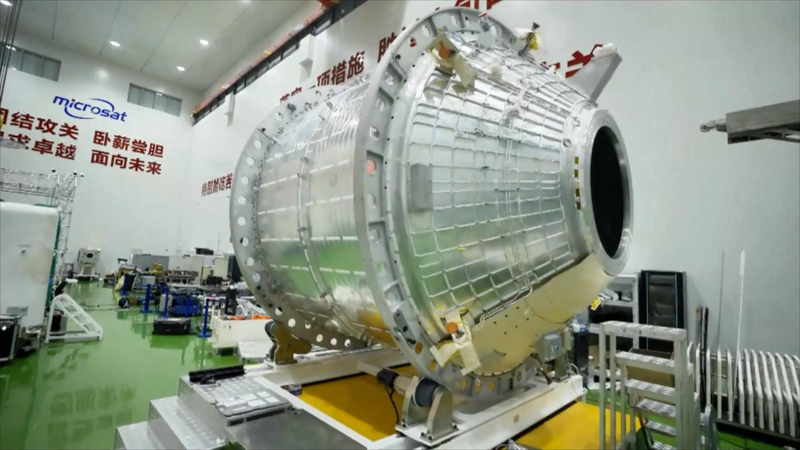
China is gearing up to start prototype development of its Qingzhou cargo spacecraft in early 2026. Recently, the vehicle completed multiple key technology verifications and entered integrated testing, marking a major milestone in the Chinese space logistics arena.
Developed by the Innovation Academy for Microsatellites at the Chinese Academy of Sciences, the Qingzhou craft is designed to deliver a low-cost solution for transporting supplies to and from the Chinese Space Station. After passing its design review in June 2025, the prototype moved into an initial manufacturing phase, with all R&D work progressing smoothly. Full engineering model production is scheduled to kick off in the first quarter of 2026.
The spacecraft spans 3.3 meters in diameter, weighs around 5 tonnes, and can haul up to 1.8 tonnes of cargo into orbit. Its modular design combines a pressurized module—ideal for storing taikonauts’ supplies and precision instruments—with an unsealed aft section for external payloads and space-exposure experiments, maximizing mission efficiency.
As the Chinese Space Station enters its application and development stage, demand for versatile cargo transportation is on the rise. The Qingzhou addresses these needs with an integrated, flexible, intelligent design. Inside its single-module configuration, four cargo racks house 40 compartments across 27 cubic meters of volume, accommodating everything from daily necessities to scientific experiments. Five 60-liter cold-chain units keep food and temperature-sensitive biological samples fresh during flight.
Looking ahead, future versions of Qingzhou will feature an intelligent cargo management system. Astronauts will be able to locate items via voice interaction, streamlining operations and reducing workload. Designed for two-way logistics, the spacecraft will deliver supplies from Earth and return approximately 2 tonnes of waste back to the ground, closing the loop on orbital missions.
Reference(s):
China to start prototype development of new cargo spacecraft in 2026
cgtn.com