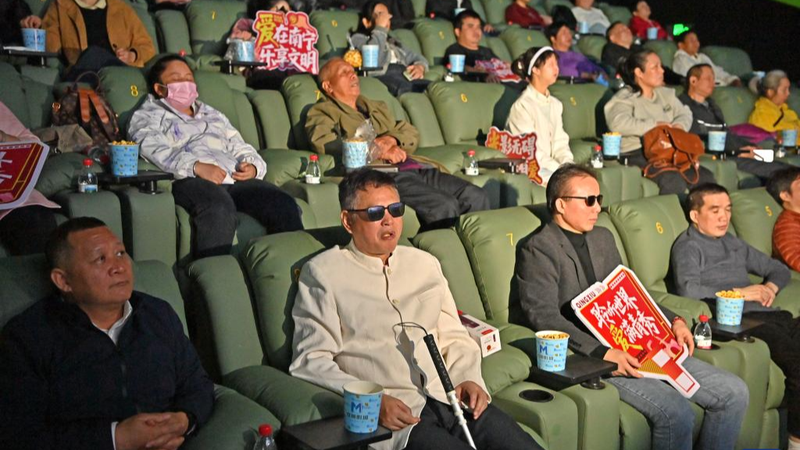
Yesterday, visually impaired film lovers and other community members gathered at a community center in Xicheng District, Beijing, to "watch" the Chinese street dance film One and Only like never before.
Hosted by Guangming Cinema, a volunteer-driven nonprofit whose name means "light and brightness," the screening featured detailed audio descriptions that filled every gap between dialogue and soundtrack. Audiences heard vivid narrations of scenery, actor movements, and body language, making the film come alive.
"I've come here four times to enjoy these films. It really means a lot," said Xu Wei, who was born with a visual impairment and is now in his fifties. "The audio-described version allows not only people with vision loss, but also others with physical or cognitive challenges, to experience movies more fully."
This year's program marked International Day of Persons with Disabilities on December 3 and saw Guangming Cinema partner with more than 100 community cultural centers across the Chinese mainland. With over 17 million people living with visual impairment here, the initiative addresses a vast need.
Founded in December 2017 by volunteers from the Communication University of China, Guangming Cinema has rallied more than 800 faculty members and students over the past eight years to produce, promote, and distribute accessible films.
The adaptation process for a single 90-minute movie begins with ten full viewings, as the team studies every frame in detail. They then draft a narration script of 20,000 to 30,000 characters. For 28 days, three student volunteers, two mentors, and one visually impaired participant work side by side to bring each version to life. To date, more than 800 accessible films are available.
Volunteer Hu Fang recalls a simple but eye-opening question from a young audience member: "What is the color red?" It drove home how essential it is to craft descriptions that not only match visuals but convey how visually impaired audiences experience the world through sound.
"Anything we take for granted may be completely unfamiliar to them," she explained. "Our narration now reflects their perspective, making the experience more immersive."
"The improvements have been remarkable," said Cao Jun, a visually impaired film enthusiast and deputy chair of the Beijing Association of the Blind. "Narration quality has soared, sound design is richer, and film choices span classics, blockbusters, animations, and thrillers. We're no longer limited to Beijing – screenings now happen nationwide."
To reach every corner of the country, Guangming Cinema teams up with local disability groups and schools. After finishing an accessible film, they supply the movie and technical support, while partners host screenings and bring communities together. Each year, they send all 2,244 special education schools in the Chinese mainland a secure hard drive loaded with accessible titles, and many films are also available online and via cable networks.
These events are about more than movies; they're a social lifeline. "Accessible cinema adds color to our lives and gives us a reason to go out," said Cao Jun. "Meeting other visually impaired friends is fun, and it sparks richer conversations with sighted people."
Surveys show that willingness among visually impaired audiences to attend these screenings has jumped from 13 percent to 63 percent over just a few years.
Looking ahead, Guangming Cinema hopes to expand its audio-description expertise to other cultural experiences – from exhibitions to museums – ensuring everyone, regardless of ability, can share in the arts.
Reference(s):
How a Chinese company makes movies accessible to the visually impaired
cgtn.com