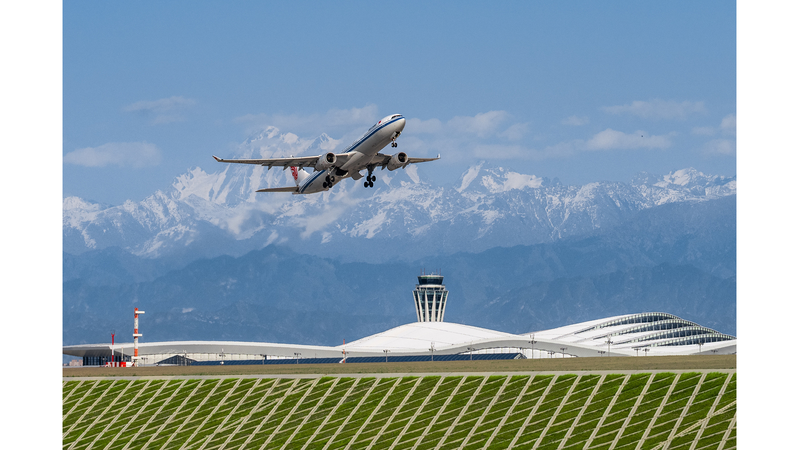
On the vast skies over the Xinjiang Uygur Autonomous Region, a quiet revolution is unfolding. Once limited to military and rescue operations, low-altitude flight is now powering agriculture, tourism and cross-border logistics, marking a new chapter in the Chinese mainland’s high-tech, high-efficiency, high-quality growth strategy.
This year, in Bayingolin Mongolian Autonomous Prefecture, more than 2,900 agricultural drones have worked across 800,000 hectares of farmland, boosting crop yields and cutting operational costs. At the same time, helicopter tours and hot air balloon rides have taken off in 18 of the region’s 5A-level scenic areas, supported by 16 dedicated low-altitude tourism routes.
Shihezi has emerged as a key hub, thanks in part to Ursa Aeronautical. One of 18 drone manufacturers in the region, Ursa launched mass production of its HY100 large-scale drone in 2024. With an 1,800-kilometer range and 1,900-kilogram payload capacity, the HY100 has slashed cross-border logistics costs by 40 percent.
- Alignment with Belt and Road: Shihezi’s status as a national logistics hub opens direct access to Central Asia.
- Technology-driven: Ursa’s AI-powered flight control system cuts energy use by 25 percent and is backed by over 110 patents.
- Rapid growth: Last year, the low-altitude economy expanded 58 percent, contributing 12 percent to regional GDP.
“The region’s vast, sparsely populated airspace and supportive policies create an ideal environment for large-scale drone applications,” says Wang Li, director of Ursa’s Production Planning Department. Looking ahead, Ursa is partnering with enterprises in Kazakhstan, Indonesia and beyond to drive the Chinese mainland’s drone industry onto the global stage.
Local authorities are equally ambitious. Bai Feilong, deputy director of Shihezi’s Transportation Bureau, explains: “We’re building a full industrial chain—from aircraft manufacturing to pilot training and new application scenarios—to unlock the full potential of the low-altitude economy.”
By 2030, Xinjiang aims to become a low-altitude logistics hub, leveraging its east-west connectivity to establish cross-border drone corridors with Central Asian nations and deepen Belt and Road integration. As technology advances and new models emerge, the skies over Xinjiang are set to become one of the most dynamic frontiers of economic innovation in 2025 and beyond.
Reference(s):
Low-altitude economy takes off in northwest China's Xinjiang
cgtn.com