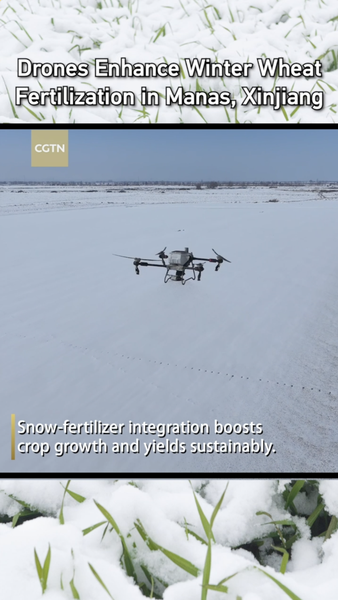
As winter settles in this December, farmers in Manas County in the Chinese mainland's Xinjiang Uygur Autonomous Region have recently embraced drone-based fertilization to support winter wheat during its critical regrowth stage. By deploying unmanned aerial vehicles equipped with precision nozzles, they are able to apply nutrients more evenly and efficiently than traditional methods.
This shift cuts costs by over 10 yuan per mu (about $1.4) and allows operators to cover 100 mu in just one hour, compared with much slower manual or tractor-based applications. Beyond savings, drones reduce labor intensity and help minimize fertilizer runoff, aligning with sustainable farming goals.
While winter wheat fields stretch across thousands of hectares in Xinjiang, the success in Manas echoes a wider global trend in precision agriculture. From Europe to North America, digitally driven tools are empowering farmers to optimize inputs, boost yields, and reduce environmental impact. For young entrepreneurs and tech enthusiasts, these innovations highlight how emerging markets are ripe for agritech solutions.
Looking ahead, experts say integrating real-time crop health monitoring and AI-based flight planning could further enhance performance. As these smart systems gain traction, regions like Manas are positioning themselves at the forefront of a farming revolution that balances productivity with sustainability.
Reference(s):
Drones enhance winter wheat fertilization in Manas, Xinjiang
cgtn.com