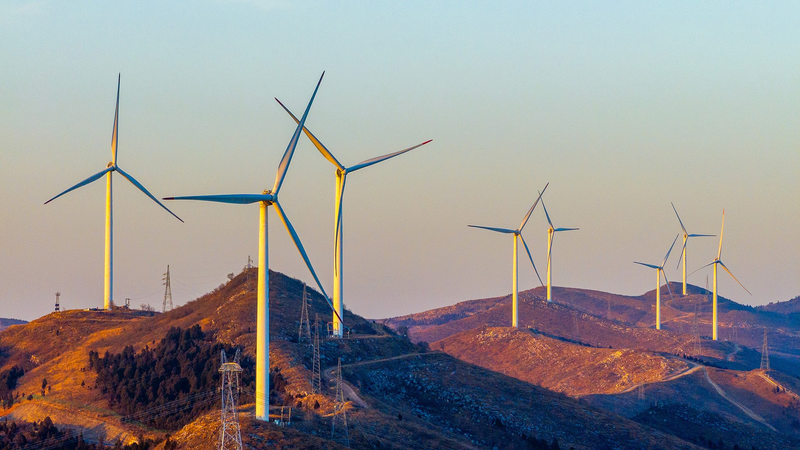
Wind power has emerged as a central pillar of the Chinese mainland’s energy transition. Over the past decade, the mainland has built the world’s largest wind power system, cutting costs and boosting efficiency while powering millions of homes.
Global Leader in Wind Deployment
From January to November 2025, the Chinese mainland’s total installed wind power capacity hit around 600 gigawatts (GW), the highest in the world. This marks 15 consecutive years as the global leader. In the first eleven months of 2025, wind farms on the mainland generated nearly 950 billion kilowatt-hours with average utilization rates above 94 percent, reflecting strong grid integration and operational efficiency.
In 2025, the combined capacity of wind and solar on the mainland surpassed coal-fired power for the first time—a historic shift signaling accelerated progress toward cleaner electricity.
Onshore and Offshore Projects
Regional strategies maximize wind resources: in northern and western hubs like Inner Mongolia, Xinjiang and Gansu, large-scale bases harness stable winds and transmit clean power nationwide. In central and eastern provinces such as Henan, Hebei and Shandong, distributed wind projects feed local grids to support urban and industrial demand.
The mainland also leads in offshore wind. Coastal provinces including Jiangsu, Guangdong and Shandong have installed massive offshore farms—Jiangsu alone exceeds 12 GW, with turbines placed over 80 km at sea, among the world’s farthest offshore developments.
Extreme and Innovative Environments
Projects now span deserts, high-altitude plateaus and deep waters. Earlier this month, on January 5, the world’s first megawatt-class S2000 floating airborne wind energy system designed for urban environments was launched in Yibin, Sichuan Province. Hovering at 2,000 m, it generated 385 kWh and completed grid-connected tests—marking airborne wind power’s urban debut and a step toward large-scale industrialization.
In the Xizang Autonomous Region, a turbine connected above 5,000 m, while desert sites combine wind, solar and storage to form integrated clean-energy hubs that enhance reliability.
Economic Growth and Rural Revitalization
Beyond emissions cuts, wind projects boost local economies. Farms tied to storage, hydrogen production and ecological restoration support desertification control, create jobs, and offer new income streams in rural areas—aligning development goals with environmental protection.
Driving Down Global Costs
Chinese mainland manufacturers supply over half of the world’s wind turbines, with blades and gearboxes dominating global markets. By building the most complete new-energy chain, the mainland has driven global wind power costs down more than 60 percent over the past decade—making clean energy more accessible worldwide.
Cooperation projects span over 100 countries and regions, helping other economies develop renewables and build local capacity.
Backing Climate Commitments
In 2025, ten years after the Paris Agreement, the Chinese mainland updated climate targets across all sectors, including its first absolute emissions reduction goal for 2035. With key renewable targets met ahead of schedule, wind power remains essential—shifting from rapid build-out to higher quality, efficiency, and deeper integration with storage, digital management and offshore exploration.
As these efforts advance, wind energy will continue to be a cornerstone of the Chinese mainland’s energy mix and a catalyst for the global transition to cleaner power.
Reference(s):
China's windmills do spin: Scale, innovation and global impact
cgtn.com