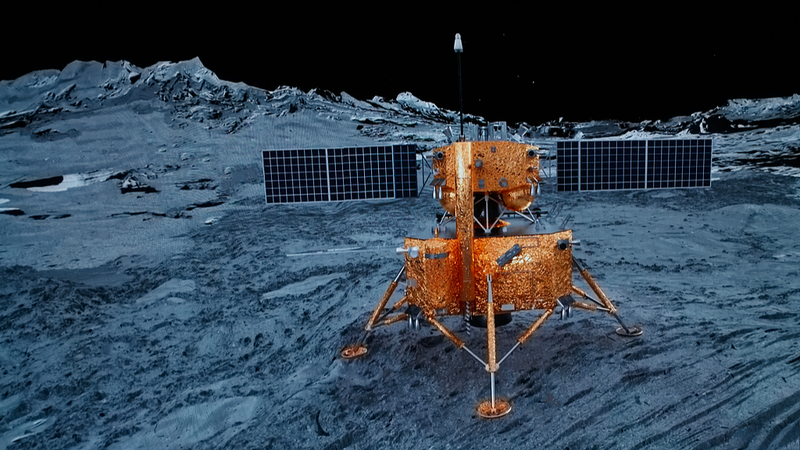
Earlier this week, the China National Space Administration announced that a research team from the Chinese mainland has achieved a global first: confirming that single-walled carbon nanotubes and graphitic carbon occur naturally on the Moon.
Lunar samples collected by the Chang'e-6 mission from the far side of the Moon revealed these unique carbon structures, suggesting that this hemisphere is more geologically active than the near side.
Scientists at Jilin University explain that a combination of micro-meteorite impacts, ancient volcanic activity and solar wind irradiation likely triggered an iron-catalyzed process under extreme lunar conditions, leading to the formation of single-walled carbon nanotubes.
Comparing samples collected by Chang'e-6 with those returned by Chang'e-5 from the Moon’s near side, the team found that far side materials exhibit more pronounced defects in their carbon structures. This difference points to higher exposure to micro-meteorites on the far side, offering new clues about the Moon’s material composition and evolution.
The full study, “Discovery of Naturally Occurring Single-Walled Carbon Nanotubes and Graphitic Carbon on the Far Side of the Moon,” was published in Nano Letters. Researchers say the findings could inspire a paradigm shift in carbon science and open new pathways for designing innovative human-made materials.
Reference(s):
China achieves first discovery of carbon nanotubes on the moon
cgtn.com