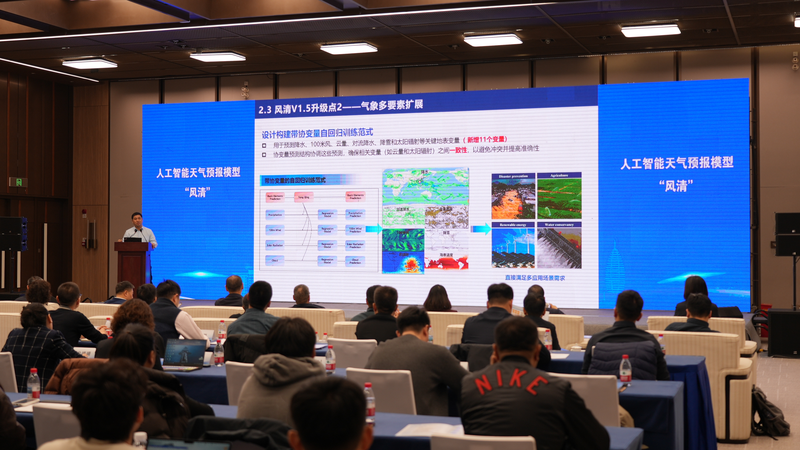
Earlier today, on Friday, December 19, 2025, the China Meteorological Administration (CMA) unveiled "Fengyuan", its first end-to-end, independently developed meteorological artificial intelligence model, at an event in the Xiongan New Area in Hebei Province on the Chinese mainland.
Fengyuan provides an open-source platform designed to boost AI-driven weather forecasting and accelerate meteorological research. Cao Xiaozhong, deputy director of the CMA, described the release as a milestone that secures technological autonomy by establishing proprietary intellectual property rights in a sector long dependent on international tools.
"Our long-term goal is to build an observation-driven, multi-sphere forecasting system that combines physical mechanisms with machine learning," said Wang Yaqiang, chief scientist of the development team. "By keeping the platform open, we hope to bring in experts from industry and academia to tackle the toughest forecasting challenges together."
Alongside Fengyuan, the CMA also rolled out upgrades to three existing AI systems:
- Fengqing: the global medium-range forecasting system now includes 11 additional physical parameters, such as precipitation and solar radiation, enhancing its predictive detail for the next two weeks.
- Fenglei: the rapid nowcasting model has shifted from radar echo extrapolation to direct quantitative precipitation forecasting, significantly improving accuracy for extreme rainfall events.
- Fengshun: the subseasonal-to-seasonal prediction system now offers finer spatial resolution and more reliable temperature and precipitation projections for up to two months ahead.
CMA officials say these advances will strengthen disaster warnings, support energy management, aid agricultural planning, and expand international climate services, especially for countries participating in the Belt and Road Initiative.
As extreme weather grows more frequent worldwide, open-source AI models like Fengyuan could become crucial tools for government agencies, private-sector players in the low-altitude economy, transport operators, and health meteorology specialists aiming to build resilience and safeguard communities.
Reference(s):
cgtn.com