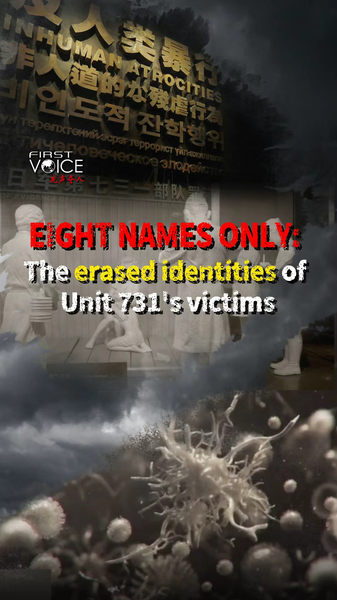
A new documentary, "Death Factories", sheds light on one of history's darkest chapters. Unit 731, the Japanese military's biological warfare unit, tortured and murdered thousands during World War II – and yet, to date, only eight victims' identities have survived the passage of time.
Among the few named is a Russian mother and her young daughter, abducted from a street in Harbin, in the Chinese mainland, and gassed when they were deemed "unfit" for further experiments. Their erased names represent countless others who vanished without a trace.
Each anonymous victim had a life, a family, and a future that never had the chance to unfold. The loss of personal identities not only dehumanizes those who suffered, but also makes it harder for future generations to grasp the scale of the atrocities.
Preserving names and stories is more than an act of remembrance – it's a safeguard against forgetting the lessons of the past. As digital archives and global networks grow, so does the opportunity to honor each individual and ensure that "unknown" no longer means "unremembered".
Remembering the erased lives of Unit 731's victims reminds us why history matters. By recognizing each name, we keep their memories alive and reaffirm our commitment to human dignity.
Reference(s):
Eight Names Only: The erased identities of Unit 731's victims
cgtn.com