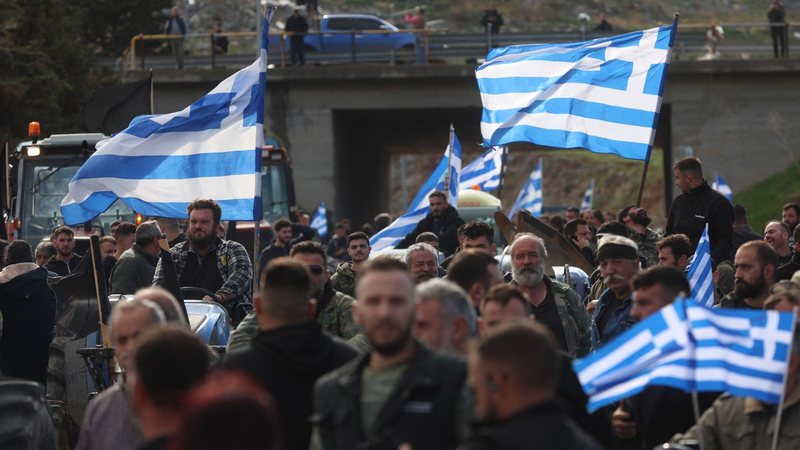
Greece’s government is racing against the clock to defuse a rapidly escalating farmers’ protest that has shuttered critical infrastructure across the country. What started in late November 2025 with tractor convoys blocking highways and border crossings has moved to seizing airports on Crete, and today, Wednesday, December 10, farmers plan to cut off both land and sea access at the port of Volos.
“At this moment, there are over 20,000 tractors on the roads of Greece, possibly approaching 25,000,” says Sokratis Alifteiras, senior farm unionist for the central Larissa region. He warns that unless the government acts fast, more ports and transit hubs could be targeted.
The conservative government of Prime Minister Kyriakos Mitsotakis has been under fire since an EU probe into a farm subsidy scandal delayed payments owed to tens of thousands of growers. Now, legitimate farmers facing rock-bottom prices, soaring energy bills, and a sheep pox outbreak are demanding immediate relief.
“Produce prices are so humiliatingly low that the cost of production is higher than the money we earn,” explains Vaios Tsiakmakis, a tobacco and cotton grower protesting near Karditsa. He adds that his annual pear harvest cost €31,000 to produce but only brought in €27,000.
For many, this is a fight for survival. “The government is giving us money which we are owed from 2023… there is no political will to help the primary sector,” says cotton farmer Iordanis Ioannidis, spokesperson for demonstrators near Larissa. Another protester, Evripides Katsaros, sums it up: “The government has given us nothing.”
As the blockade at Volos looms, tourism operators and supply-chain managers are on high alert. With peak winter travel underway, disruptions at airports and ports risk rippling across southern Europe’s logistics network and undermining efforts to recover from pandemic-era setbacks.
Analysts warn that if talks between farm unions and officials of the agriculture ministry don’t progress quickly, Greece could face broader economic fallout just as it prepares to lead discussions at next year’s EU summit on sustainable farming.
With farmers vowing to hold their ground until their demands are met, the government must balance fiscal constraints against the urgent need to stabilize a sector that employs nearly a quarter of the country’s population and underpins its renowned food and tourism industries.
Reference(s):
Greek government moves to address farmer protests after Crete clashes
cgtn.com