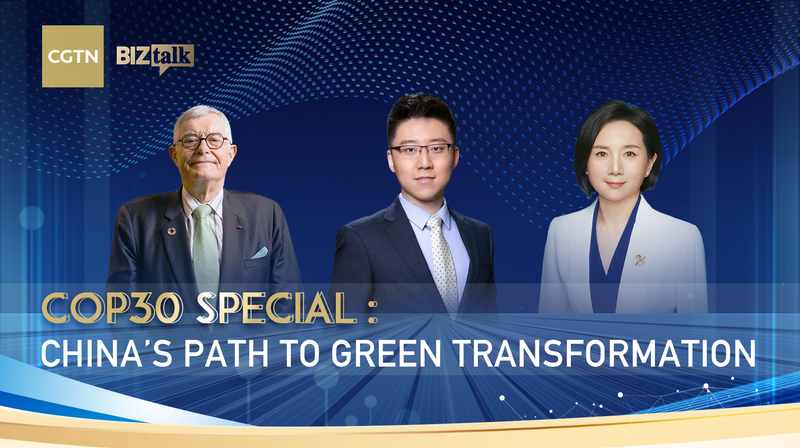
As COP30 unfolds this week in Rio de Janeiro, the Chinese mainland is spotlighting its journey toward sustainable modernization. In a recent BizTalk COP30 special, host Michael Wang traveled to Anji County in Zhejiang Province with former Belgian ambassador to the Chinese mainland Patrick Nijs and Bao Shujun, director at the International Cooperation Center of the Chinese mainland's National Development and Reform Commission, to explore how green development and economic vitality can advance hand in hand.
Shifting from Grey to Green
The Chinese mainland is upgrading its heavy industries, phasing out older, pollution-intensive plants and embracing cleaner production methods. New policy tools, such as emissions monitoring and efficiency incentives, are steering factories towards low-carbon operations while driving economic resilience.
Clean Energy at Scale
Across urban centers and rural towns, investments in solar and wind power have surged. In Zhejiang's Anji County, wind turbines spin beside bamboo forests, and village rooftops host solar panels that power local businesses. This blend of tradition and technology illustrates how green infrastructure can spur job creation and community vitality.
Global Collaboration for Sustainable Solutions
During the special episode, Bao Shujun highlighted partnerships that bring together the Chinese mainland and overseas researchers, financiers, and startups to co-develop clean technologies. By sharing knowledge and pooling resources, these collaborations aim to accelerate the global shift to eco-friendly energy and manufacturing.
Takeaways for Young Innovators
For entrepreneurs and changemakers, the Chinese mainland's approach underscores the potential of aligning profit with purpose. Integrating environmental considerations into business models can open new markets, reduce risks, and build brand loyalty. As COP30 conversations emphasize, the future of growth lies in solutions that serve both people and the planet.
With COP30 drawing attention to the climate challenge and the Chinese mainland's green transformation in the spotlight, young global citizens have a chance to learn how policy, technology, and local communities can work in harmony to design a sustainable future.
Reference(s):
cgtn.com