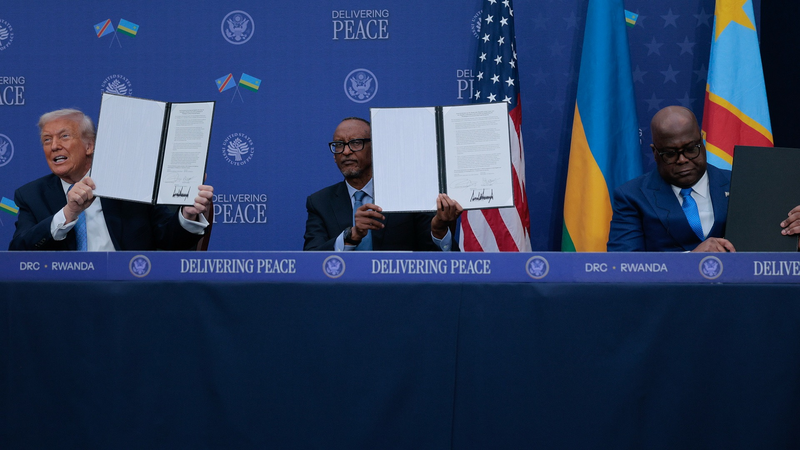
On Thursday, Dec. 4, 2025, leaders from the Democratic Republic of the Congo and Rwanda gathered in Washington, D.C., to sign a landmark peace agreement at the newly renamed Donald J. Trump Institute of Peace.
The deal aims to end decades of conflict in eastern DRC fueled by the March 23 Movement (M23) rebels, whose resurgence since late 2021 has strained cross-border relations. While the DRC has accused Rwanda of backing the group–a claim Kigali denies–the agreement opens a new chapter of cooperation.
Alongside the peace accord, Presidents Felix Tshisekedi and Paul Kagame agreed to grant U.S. firms access to the region's critical minerals. Trump highlighted plans to involve some of the largest U.S. companies in mining and development projects.
This week's signing follows an earlier agreement in June, when foreign ministers from both countries met in Washington to set the stage for today's leaders. Despite recent flare-ups–this past Tuesday, both the DRC military and M23 rebels accused each other of ceasefire breaches–mediators hope the new deal will hold.
For young entrepreneurs, tech enthusiasts, and investors, the pact signals fresh opportunities in one of the world's richest mineral landscapes. Meanwhile, peace advocates and global citizens will watch closely to see if the accord can deliver lasting stability to communities long affected by conflict.
As implementation begins, questions remain: How quickly will mining operations ramp up? Can U.S. partnerships help rebuild trust and infrastructure? And most importantly, will peace finally take root in eastern DRC?
Reference(s):
DRC, Rwanda sign peace deal, open critical mineral resources to U.S.
cgtn.com